
Ask a primary school teacher what their job is and they’ll say “teaching.” Watch one for a week and you’ll see something else: writing worksheets on Sunday night, marking forty scripts on Tuesday, copying scores into a spreadsheet on Friday, and somewhere in between, trying to remember whether Wing-yan is still struggling with inference or has finally turned the corner.
The teaching, the part they signed up for, is squeezed by everything around it. That’s the problem I’ve been working on with Hoklok (學樂), a platform for Hong Kong primary schools, and it has changed my mind about what “AI in education” should mean. Not an AI tutor that replaces the teacher. An assistant that takes the production work off their desk while leaving every decision in their hands.
The name is two characters: 學 (hok6), to learn, and 樂 (lok6), joy. The pairing is older than the company. The Analects opens with Confucius asking 學而時習之,不亦說乎, roughly “to learn, and in time put it into practice, is that not a joy?” Twenty-five centuries later that’s still the wager: when the work fits the learner, practice stops feeling like punishment. We named the platform after that feeling so we’d be held to it.
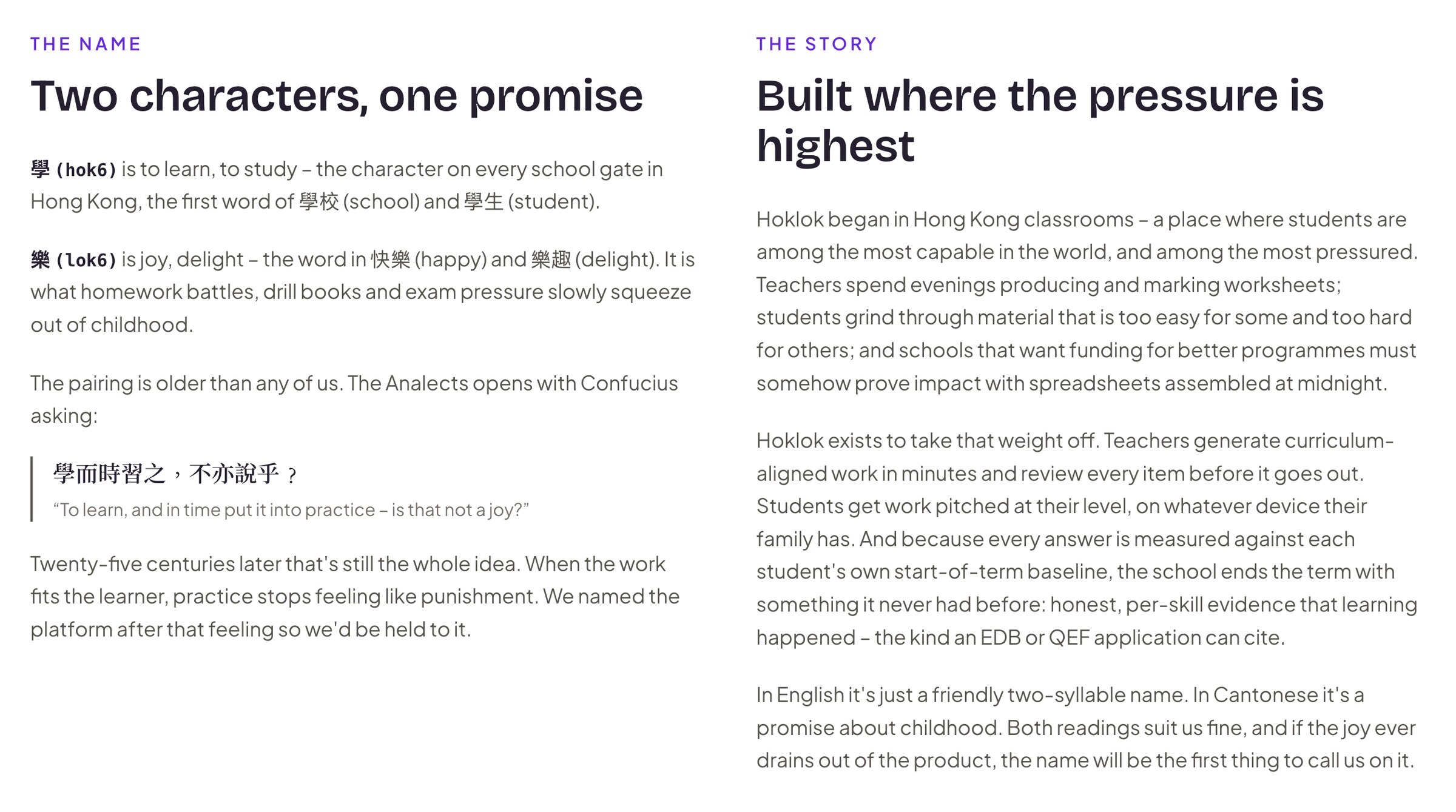 Two characters, one promise, and the classroom pressure Hoklok was built to relieve.
Here’s what that looks like in practice.
Personalised homework, without forty times the work#
Every teacher knows a bored student learns less. A reading comprehension about “a day at the market” lands differently on the kid who loves rockets than the one who loves egg tarts. The traditional fix, differentiated worksheets, is wonderful and completely impractical: nobody has time to write four versions of Tuesday’s homework.
With generation costs approaching zero, that trade-off disappears. In Hoklok, students pick their own top interests from ten categories: Space & Science, Food & Cooking, Animals & Nature, and so on. When a teacher generates homework for a class, the system quietly splits the class by primary interest and produces one variant per group. Same topic, same skills tested, same difficulty, same number of questions, but the space kids get a passage about model rockets in the science room, and the food kids get one about egg tarts from the school canteen.
The teacher fills in one form: subject, topic, level, difficulty, question counts. The class splits itself. And when a single common worksheet is the right call, a test, a baseline, there’s a toggle for that too. Personalisation should be a choice, not a mandate.
This isn’t just a nice idea. It’s one of the more replicated findings in learning science. Walkington and Bernacki’s work on situational interest found that rewriting math problems around students’ own out-of-school interests raised engagement, accuracy, and learning efficiency inside intelligent tutoring systems, and that the effect showed up on classroom exam performance, not just inside the tool.1 A 2026 meta-analysis of AI-supported personalized feedback across dozens of studies found consistent gains in both learning outcomes and motivation, with the strongest effects where the personalization was specific rather than generic.2 The mechanism researchers describe is worth sitting with: a well-chosen interest triggers situational interest, a short-term spike in attention, and repeated exposure is what has a chance of turning that into individual interest in the subject itself. A worksheet about rockets doesn’t just make Tuesday more fun. Done enough times, it’s a plausible route into actually liking science.
The teacher is the editor-in-chief#
The part I feel most strongly about: nothing generated ever reaches a student without a teacher’s sign-off.
Each variant lands in a review screen where the teacher can read every question, edit the wording, fix an option, change the marks a question carries, ask for a completely fresh take on one variant, or reject it outright. Then they decide when it goes out and when attempts close.
This matters because language models are excellent drafters and unreliable authorities. The right mental model is a hardworking assistant who produces a solid first draft in thirty seconds, and a teacher who spends two minutes reviewing instead of forty-five minutes writing. The judgement stays where it belongs.
Marking that teaches, not just scores#
Multiple-choice and fill-in-the-blank questions mark themselves the moment a student submits, that part is table stakes. The interesting question is what the student sees next.
A score alone teaches nothing. So every generated question carries its feedback with it: why the right answer is right, why the specific option you picked is wrong, and, for reading comprehension, the exact sentence in the passage that holds the answer. When a student taps “Show answers,” each missed question gets its own colour, and the evidence for it is underlined in that colour in the passage. Getting a question wrong turns into a guided re-read instead of a red cross.
Written answers still go to the teacher, a marking queue with the student’s work and one-tap scoring. AI handles the part it’s reliable at. Humans handle the part that needs judgement.
Progress you can see, not just feel#
Good teachers carry a mental model of every student. But mental models don’t survive forty students, and they can’t be handed to a colleague, a parent, or a funding body.
Because every answer in the platform is an event, tagged with the specific skill it assesses, whether it was right, and how long the student actively spent, the tracking builds itself. No Friday spreadsheet session. The teacher sees submission rates per assignment, class-level skill gaps, and each student’s trajectory against their baseline. The difference between “Wing-yan seems weaker at inference” and “Wing-yan has missed inference questions three weeks running, but her vocabulary scores are climbing” is the difference between a hunch and a plan.
For schools, the same event stream becomes something bigger: evidence. When you apply for funding or report to the Education Bureau, “we adopted technology” is a weak sentence. “Here is the measured skill growth of 120 students over a term” is a strong one.
The unglamorous parts are the point#
Two design choices that no one will ever put in a demo video, but that make the whole thing viable for schools:
Each school’s data lives in its own database. Not a shared table with a school-ID column, a physically separate database per school. Student data is sensitive, and isolation should be structural, not a filter clause.
Schools bring their own AI keys. The platform doesn’t lock anyone into one model vendor. Whichever provider a school trusts, and whichever one their budget allows, plugs in.
Where this fits in a fast-moving market#
None of this is happening in a vacuum. Generative AI adoption in education has gone from novelty to default in about two years: 86 percent of education organisations now report using generative AI, teachers who use AI tools weekly save an average of 5.9 hours a week, and over half say it has freed up more time to actually interact with students rather than prepare for them.3 The market backing that shift is growing just as fast, from roughly 8.3 billion US dollars in 2025 toward a market more than ten times that size within a decade.4 Hong Kong’s own Education Bureau formalised the direction in June 2026 with its Blueprint for Digital Education Development, which makes digital literacy and AI use part of the core primary curriculum rather than an optional extra.5
That growth has produced real competition, and it’s worth being specific about where Hoklok sits in it rather than pretending the category is empty.
Khanmigo is a Socratic tutor that talks directly to the student, deliberately withholding answers to prompt reasoning. It’s excellent at what it does, but the teacher isn’t in that loop by design.6 MagicSchool, Diffit, and Monsha sit closer to Hoklok’s territory: teacher-facing tools that generate worksheets and adjust reading level, Lexile score, or Bloom’s Taxonomy tier.7 What they generally don’t do is split a single assignment across a class by topical interest, they differentiate by difficulty and readability, not by what a nine-year-old actually cares about. Squirrel AI, deployed at genuine scale across China with tens of millions of enrolled students, and Century Tech in the UK, take a third approach: adaptive systems that map skill gaps and algorithmically resequence what a student sees next until they reach mastery.8 That’s a powerful model for closing gaps, and the results are real, but the system is largely driving, and the teacher’s editorial role shrinks accordingly.
Hoklok’s bet is that these are different jobs. Adaptive mastery systems optimise for closing a known skill gap as efficiently as possible. Interest personalization optimises for something upstream of that: whether a student wants to engage with the material at all. A teacher who has read every question before it reaches a student, and can override any of it in two minutes, is doing something a fully automated tutor structurally can’t. Combined with per-school data isolation and the freedom to bring your own model, that’s the specific gap Hoklok is built for, not a better version of an adaptive tutor, but a tool that keeps the personalization decision close to the interest data schools already have (what their students like) and the judgment only a teacher can supply.
What I’ve learned#
Building this has made me optimistic in a specific, narrow way. I don’t believe AI will replace teachers, and I’m suspicious of anyone selling that future. The teacher-student relationship, noticing the quiet kid, knowing when to push and when to encourage, is the product. Everything else is packaging.
But the packaging currently consumes teachers’ evenings. Worksheet production, first-pass marking, feedback writing, progress bookkeeping: these are exactly the shape of work that today’s AI does well, under supervision. Automating them doesn’t diminish the teacher. It returns the job to what they signed up for.
The best summary I have is the arithmetic of one feature: a class of forty students, four interest groups, four themed worksheets, generated in about a minute, reviewed in five. A year ago that was an afternoon of work. That afternoon now belongs to the teacher again.
Rishi is building Hoklok (學樂), a personalised-learning platform for Hong Kong primary schools. If you run a school and want to try it, get in touch.
Candace Walkington and Matthew L. Bernacki, “The Role of Situational Interest in Personalized Learning,” Journal of Educational Psychology, https://www.researchgate.net/publication/320564894_The_Role_of_Situational_Interest_in_Personalized_Learning ↩︎
Wenxuan Wang et al., “The Effectiveness of AI-Supported Personalized Feedback on Students’ Learning Outcomes and Motivation: A Meta-Analysis,” 2026, https://journals.sagepub.com/doi/10.1177/07356331251410020 ↩︎
Microsoft, “Microsoft’s New AI in Education Report highlights widespread adoption and increasing demand for support,” June 2026, https://news.microsoft.com/source/2026/06/24/microsofts-new-ai-in-education-report-highlights-widespread-adoption-and-increasing-demand-for-support/ ↩︎
Grand View Research, AI in Education Market Size, Share and Growth Report, https://www.grandviewresearch.com/industry-analysis/artificial-intelligence-ai-education-market-report ↩︎
OpenGov Asia, “Hong Kong Sets Blueprint for Digital Education in Primary and Secondary Schools,” June 2026, https://opengovasia.com/hong-kong-sets-blueprint-for-digital-education-in-primary-and-secondary-schools/ ↩︎
IntegratED Teacher, “Khanmigo vs. MagicSchool vs. ChatGPT,” https://www.integratedteacher.com/blog/khanmigo-vs-magicschool-vs-chatgpt ↩︎
Comparison of AI worksheet and differentiation tools (Diffit, MagicSchool, Monsha) via We Are Teachers, https://www.weareteachers.com/ai-worksheet-generators/ and Monsha, https://monsha.ai/blog/7-best-ai-worksheet-generator-tools-for-teachers ↩︎
Squirrel AI scale and results per Wikipedia, https://en.wikipedia.org/wiki/Squirrel_AI, and Newsweek, “How China’s Kids Are Getting an Edge With AI,” https://www.newsweek.com/how-chinas-kids-are-getting-an-edge-with-ai-11998409; Century Tech’s adaptive model as described by Learning Success, https://learningsuccess.blog/news/education-innovation/hong-kong-schools-deploy-ai-tools-to-personalize-learning-for-every-child/ ↩︎